데이터 접근 기술 - 시작
- 김영한님의 스프링 DB 2편 강의를 통해 데이터 접근 기술의 종류와 특징, 그리고 프로젝트 구조에 대해 정리함
데이터 접근 기술
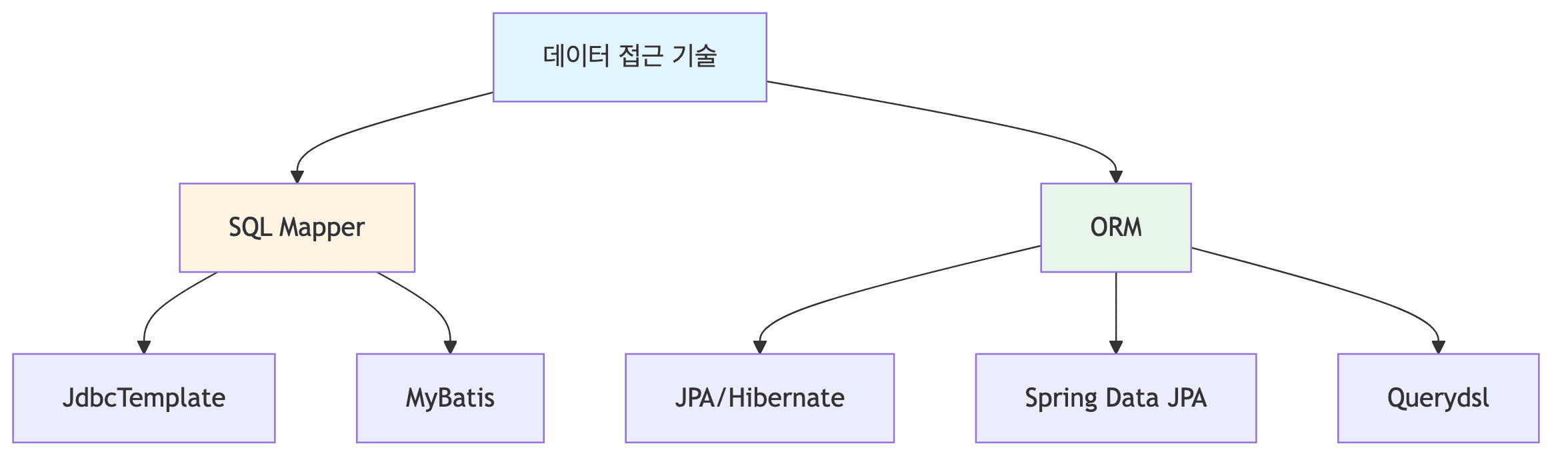
SQL Mapper
| 기술 | 특징 | 장점 | 단점 |
|---|---|---|---|
| JdbcTemplate | 스프링 내장 | 설정 간단, 빠른 학습 | SQL 직접 작성 |
| MyBatis | XML/어노테이션 매핑 | 복잡한 쿼리 작성 용이 | 설정 필요 |
- 개발자가 SQL을 직접 작성함
- JDBC의 반복 코드를 제거해줌
- 결과를 객체로 자동 매핑해줌
ORM

- 데이터베이스 테이블과 객체를 매핑함
- 개발자가 SQL을 직접 작성하지 않아도 JPA가 자동으로 SQL을 생성하고 실행함
- 데이터베이스 벤더가 변경되어도 코드를 수정할 필요가 거의 없음
- JPA (Java Persistence API)
- 자바의 ORM 표준 인터페이스
- Hibernate
- JPA 인터페이스의 대표적인 구현체
- 실제 내부 동작을 담당함
- Spring Data JPA
- JPA를 더욱 편리하게 사용할 수 있도록 도와주는 스프링 프레임워크의 모듈
- Querydsl
- 복잡한 동적 쿼리나 조인 등을 자바 코드로 안전하게 작성할 수 있게 도와주는 프레임워크
프로젝트 구조 - 도메인과 리포지토리
전체 아키텍처
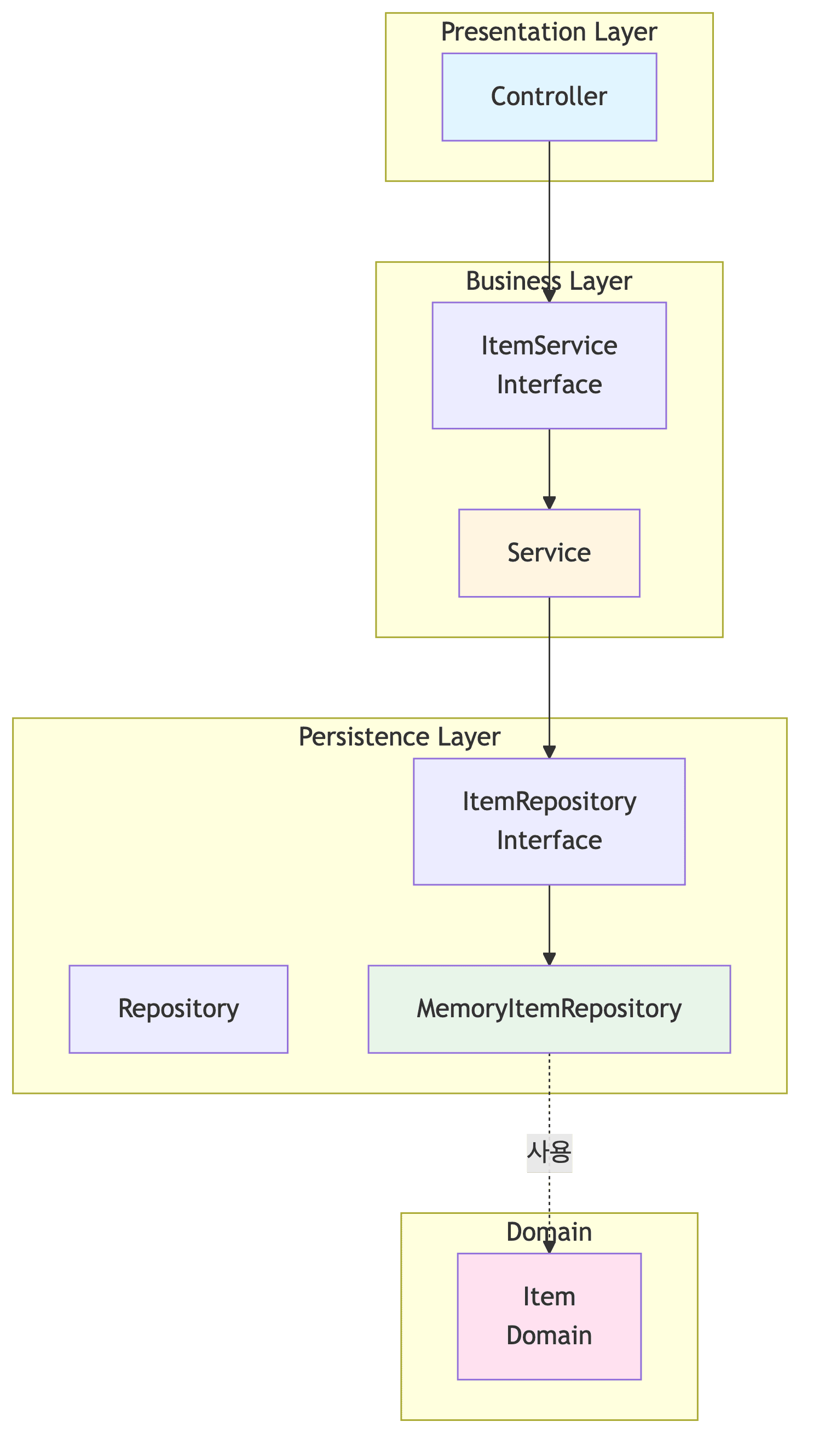
도메인 모델
-
Item 엔티티
-
1
2
3
4
5
6
7
8
9
10
11
12
13
14
15
  @Data
  public class Item {
      private Long id;
      private String itemName;
      private Integer price;
      private Integer quantity;

      public Item() {} // JPA 등 프레임워크 사용 시 필수

      public Item(String itemName, Integer price, Integer quantity) {
          this.itemName = itemName;
          this.price = price;
          this.quantity = quantity;
      }
  }
id는 생성자에서 제외함 (DB가 자동 생성)Integer를 사용함 (null 허용을 위해)- 기본 생성자가 필수임 (JPA, 프레임워크 호환)
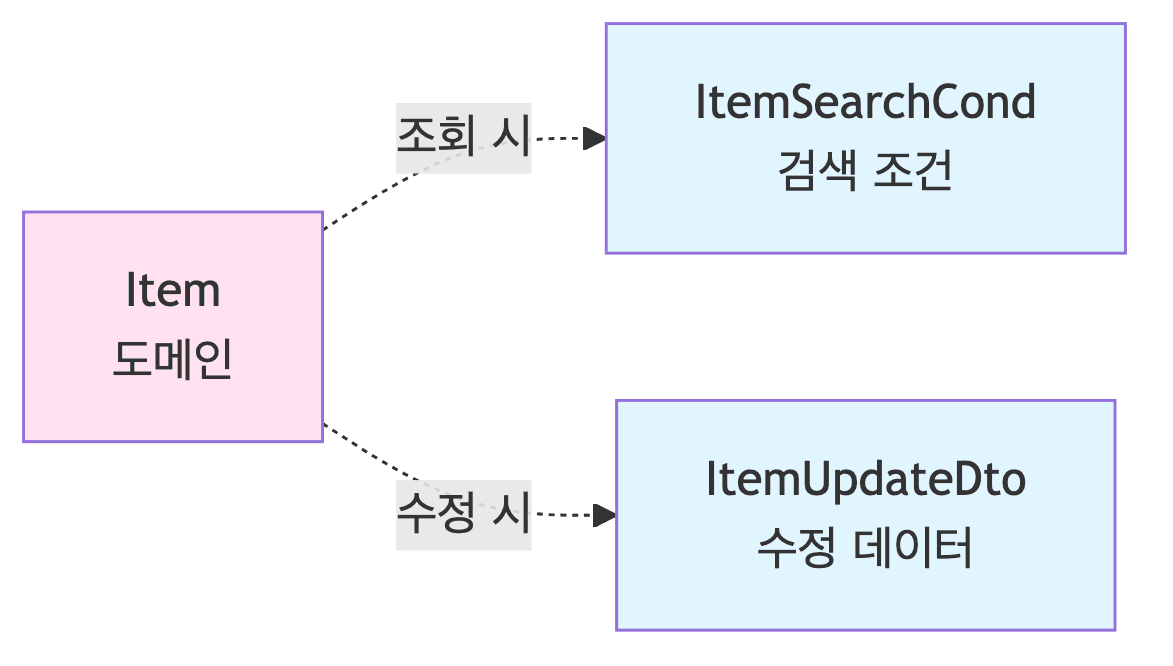
DTO 설계
-
ItemSearchCond (검색 조건)
1
2
3
4
5
6
7
8
9
10
11
12
  @Data
  public class ItemSearchCond {
      private String itemName; // 검색어
      private Integer maxPrice; // 최대 가격

      public ItemSearchCond() {}

      public ItemSearchCond(String itemName, Integer maxPrice) {
          this.itemName = itemName;
          this.maxPrice = maxPrice;
      }
  }
-
ItemUpdateDto (수정 데이터)
1
2
3
4
5
6
7
8
  @Data
  public class ItemUpdateDto {
      private String itemName;
      private Integer price;
      private Integer quantity;

      // id는 제외 (URL 경로로 넘어오므로 DTO에 불필요)
  }
- DTO 사용 이유
- 명확한 의도 표현
- 수정용 객체인지 조회용 객체인지 이름만으로 명확하게 알 수 있음 (
ItemUpdateDto)
- 수정용 객체인지 조회용 객체인지 이름만으로 명확하게 알 수 있음 (
- 불필요한 데이터 노출 방지
id처럼 수정하면 안 되거나 필요 없는 데이터를 제외하여 안전성을 높임
- 도메인 모델 보호
- 도메인 객체를 그대로 사용하면 화면이나 API 요구사항에 따라 도메인 로직이 변경될 위험이 있음
- 명확한 의도 표현
- DTO 사용 이유
리포지토리 인터페이스
-
1
2
3
4
5
6
7
8
9
  public interface ItemRepository {
      Item save(Item item);

      void update(Long itemId, ItemUpdateDto updateParam);

      Optional<Item> findById(Long id);

      List<Item> findAll(ItemSearchCond cond);
  }
-
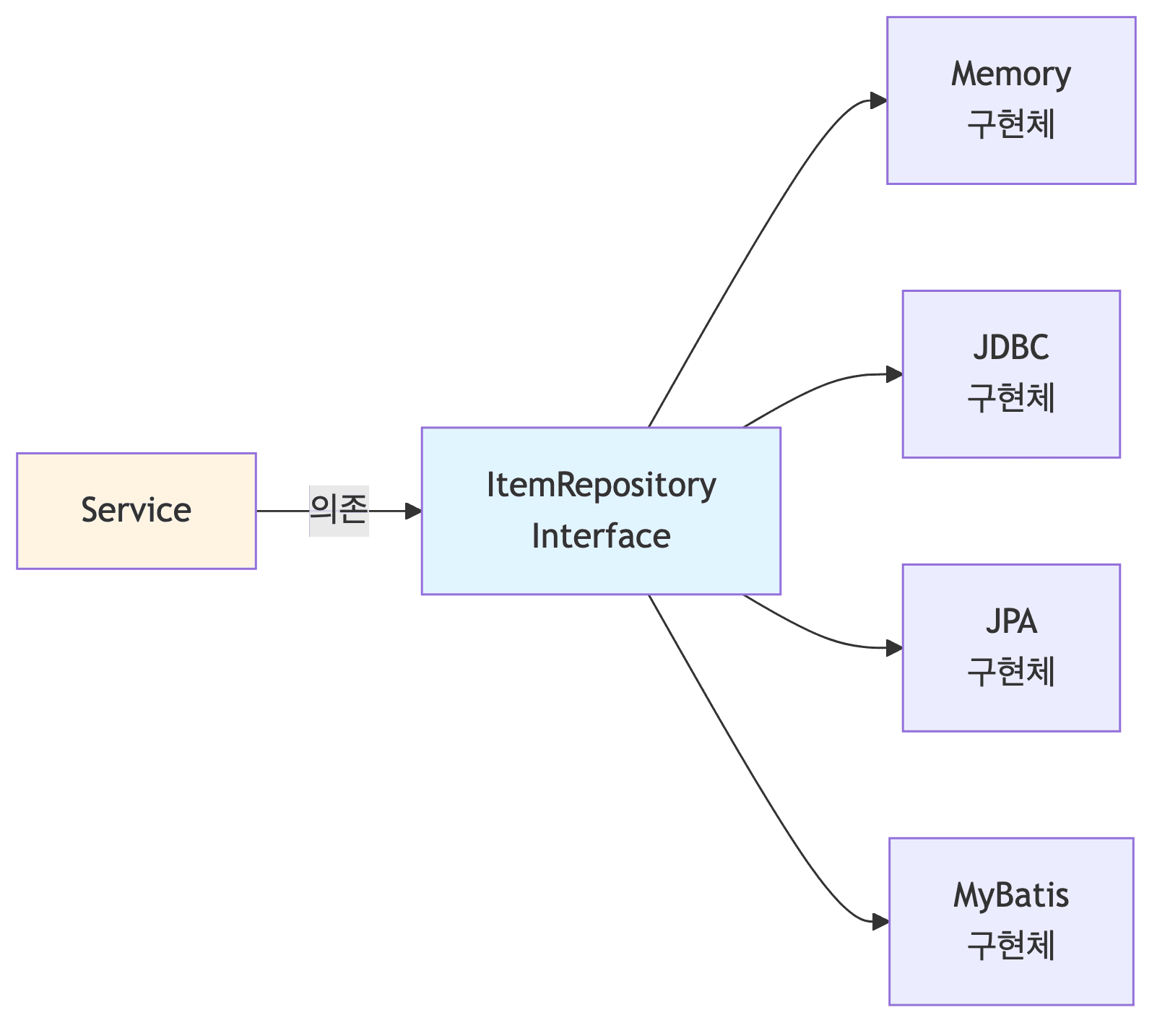
인터페이스 도입 이유
- 장점
- 구현 기술 변경이 용이함
- 테스트 시 Mock 사용이 가능함
- OCP 원칙을 준수할 수 있음
- 장점
메모리 리포지토리 구현
-
1
2
3
4
5
6
7
8
9
10
11
12
13
14
15
16
17
18
19
20
21
22
23
24
25
26
27
28
29
30
31
32
33
34
35
36
37
38
39
40
41
42
43
44
45
46
47
  @Repository
  public class MemoryItemRepository implements ItemRepository {
      private static final Map<Long, Item> store = new HashMap<>(); // 메모리 저장소
      private static long sequence = 0L;

      @Override
      public Item save(Item item) {
          item.setId(++sequence);
          store.put(item.getId(), item);
          return item;
      }

      @Override
      public void update(Long itemId, ItemUpdateDto updateParam) {
          Item findItem = findById(itemId).orElseThrow();
          findItem.setItemName(updateParam.getItemName());
          findItem.setPrice(updateParam.getPrice());
          findItem.setQuantity(updateParam.getQuantity());
      }

      @Override
      public Optional<Item> findById(Long id) {
          return Optional.ofNullable(store.get(id));
      }

      @Override
      public List<Item> findAll(ItemSearchCond cond) {
          String itemName = cond.getItemName();
          Integer maxPrice = cond.getMaxPrice();

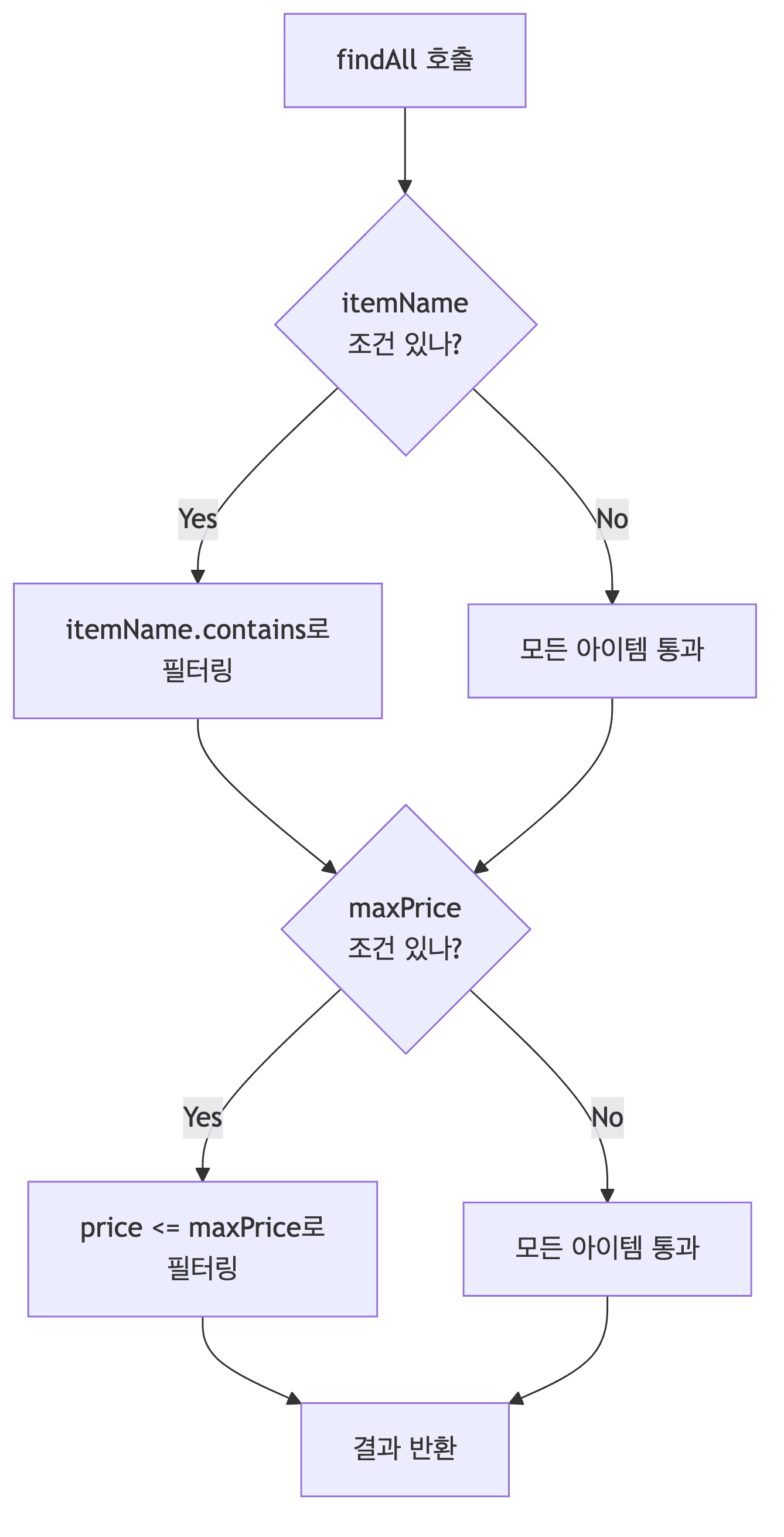
          // 자바 스트림으로 필터링 구현
          return store.values().stream()
              .filter(item -> {
                  if (ObjectUtils.isEmpty(itemName)) return true;
                  return item.getItemName().contains(itemName); // 부분 일치
              })
              .filter(item -> {
                  if (maxPrice == null) return true;
                  return item.getPrice() <= maxPrice; // 가격 제한
              })
              .collect(Collectors.toList());
      }

      public void clearStore() {
          store.clear(); // 테스트 격리를 위한 메서드
      }
  }
-
검색 로직 흐름
프로젝트 구조 - 서비스와 컨트롤러
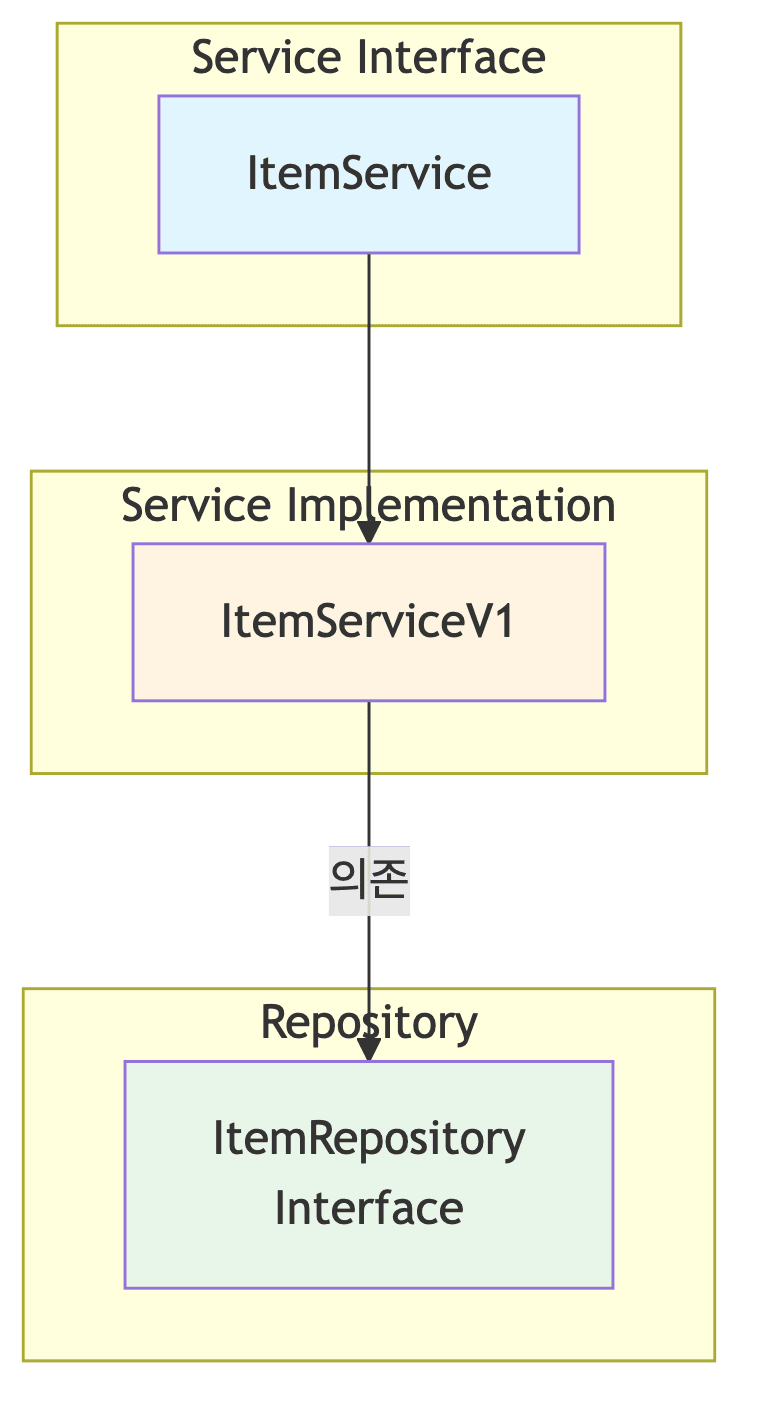
서비스 계층
-
ItemService 인터페이스
1
2
3
4
5
6
7
8
9
  public interface ItemService {
      Item save(Item item);

      void update(Long itemId, ItemUpdateDto updateParam);

      Optional<Item> findById(Long id);

      List<Item> findItems(ItemSearchCond itemSearch);
  }
-
ItemServiceV1 구현체
1
2
3
4
5
6
7
8
9
10
11
12
13
14
15
16
17
18
19
20
21
22
23
24
25
  @Service
  @RequiredArgsConstructor // final 필드 생성자 자동 생성
  public class ItemServiceV1 implements ItemService {
      private final ItemRepository itemRepository;

      @Override
      public Item save(Item item) {
          return itemRepository.save(item); // 리포지토리에 위임
      }

      @Override
      public void update(Long itemId, ItemUpdateDto updateParam) {
          itemRepository.update(itemId, updateParam);
      }

      @Override
      public Optional<Item> findById(Long id) {
          return itemRepository.findById(id);
      }

      @Override
      public List<Item> findItems(ItemSearchCond cond) {
          return itemRepository.findAll(cond);
      }
  }
- 대부분의 로직을 리포지토리에 위임함
컨트롤러 계층
-
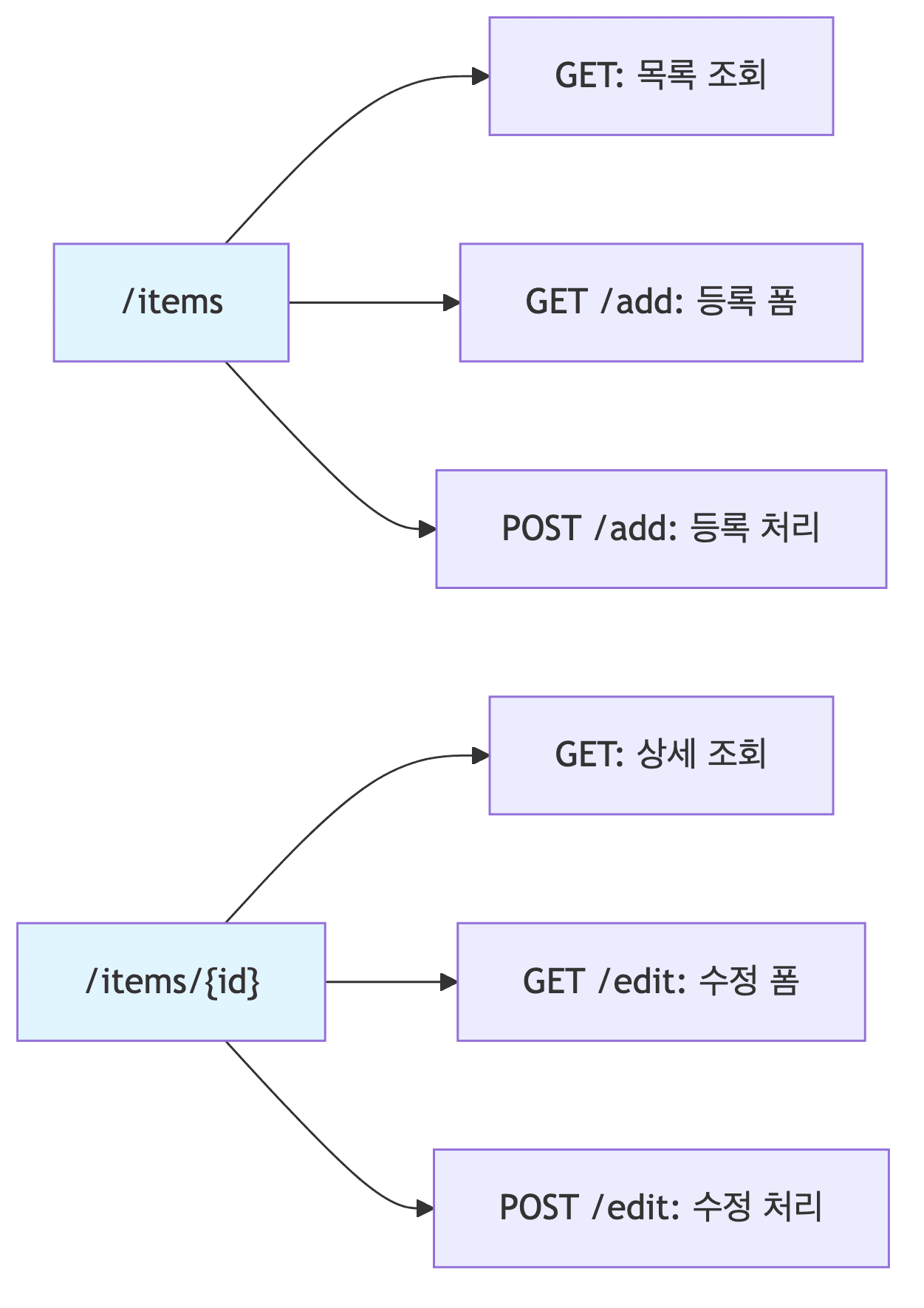
주요 엔드포인트
-
ItemController
1
2
3
4
5
6
7
8
9
10
11
12
13
14
15
16
17
18
19
20
21
22
23
24
25
26
27
28
29
30
31
32
33
34
  @Controller
  @RequestMapping("/items")
  @RequiredArgsConstructor
  public class ItemController {
      private final ItemService itemService;

      @GetMapping
      public String items(@ModelAttribute("itemSearch") ItemSearchCond itemSearch, Model model) {
          List<Item> items = itemService.findItems(itemSearch);
          model.addAttribute("items", items);
          return "items"; // 뷰 템플릿 반환
      }

      @GetMapping("/{itemId}")
      public String item(@PathVariable long itemId, Model model) {
          Item item = itemService.findById(itemId).get();
          model.addAttribute("item", item);
          return "item";
      }

      @PostMapping("/add")
      public String addItem(@ModelAttribute Item item, RedirectAttributes redirectAttributes) {
          Item savedItem = itemService.save(item);
          redirectAttributes.addAttribute("itemId", savedItem.getId());
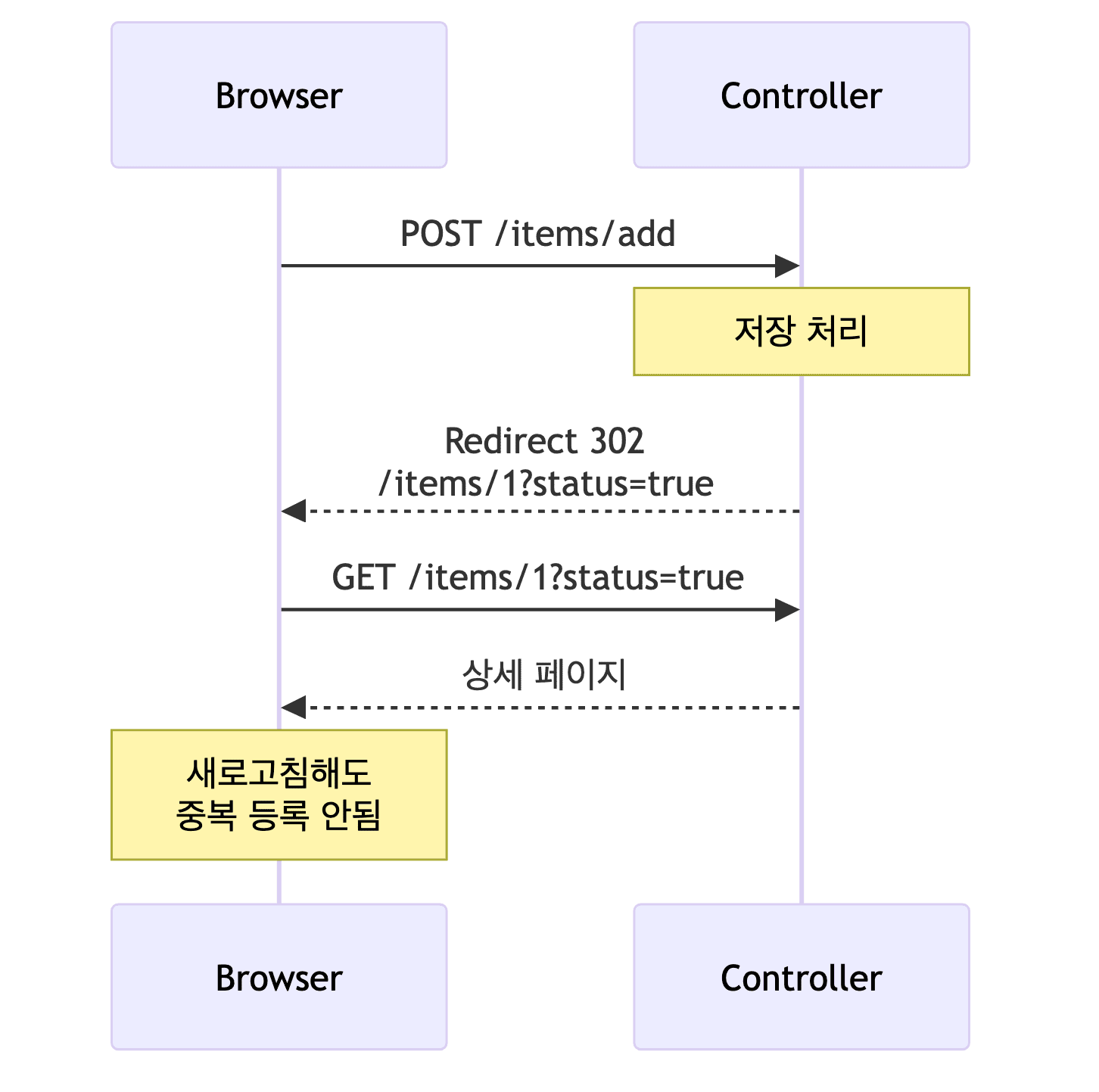
          redirectAttributes.addAttribute("status", true); // 쿼리 파라미터로 전달됨
          return "redirect:/items/{itemId}"; // PRG 패턴 적용
      }

      @PostMapping("/{itemId}/edit")
      public String edit(@PathVariable Long itemId, @ModelAttribute ItemUpdateDto updateParam) {
          itemService.update(itemId, updateParam);
          return "redirect:/items/{itemId}";
      }
  }
-
PRG 패턴 (Post-Redirect-Get)
-
프로젝트 설정
의존성 구성
1
2
3
4
5
6
7
8
9
10
11
12
13
14
dependencies {
    // 웹 & 뷰
    implementation 'org.springframework.boot:spring-boot-starter-thymeleaf'
    implementation 'org.springframework.boot:spring-boot-starter-web'

    // 유틸리티
    compileOnly 'org.projectlombok:lombok'
    annotationProcessor 'org.projectlombok:lombok'

    // 테스트
    testImplementation 'org.springframework.boot:spring-boot-starter-test'
    testCompileOnly 'org.projectlombok:lombok'
    testAnnotationProcessor 'org.projectlombok:lombok'
}
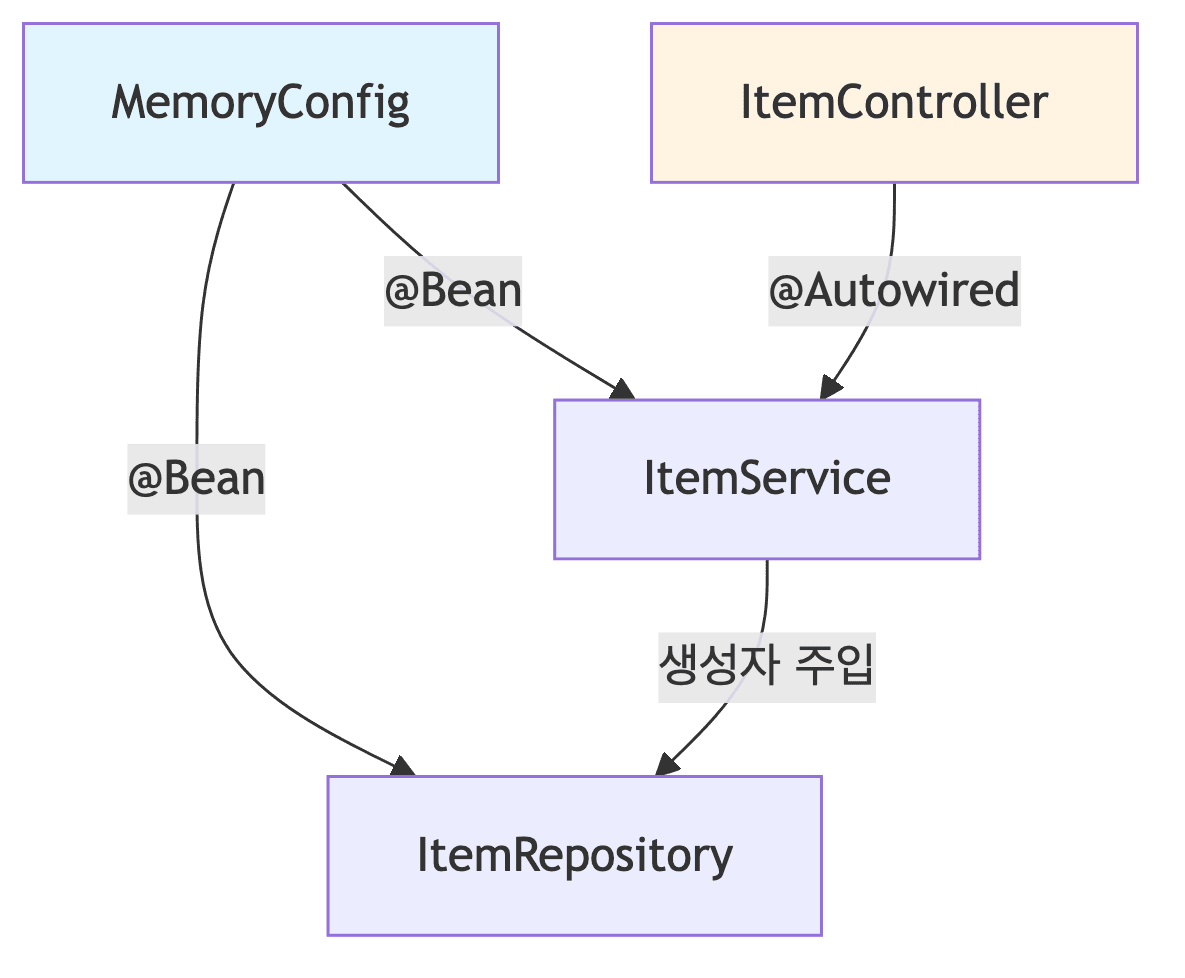
스프링 빈 설정
-
MemoryConfig
1
2
3
4
5
6
7
8
9
10
11
12
13
  @Configuration
  public class MemoryConfig {

      @Bean // 빈 직접 등록
      public ItemService itemService() {
          return new ItemServiceV1(itemRepository());
      }

      @Bean
      public ItemRepository itemRepository() {
          return new MemoryItemRepository(); // 추후 구현체 교체의 유연성을 위해 수동 등록
      }
  }
- 수동 빈 등록 이유
- 구현체를 쉽게 교체하기 위함임
- 컨트롤러는 컴포넌트 스캔을 사용함
- 수동 빈 등록 이유
-
메인 애플리케이션
1
2
3
4
5
6
7
8
9
10
11
12
13
14
  @Import(MemoryConfig.class) // 설정 파일 추가
  @SpringBootApplication(scanBasePackages = "hello.itemservice.web") // 컴포넌트 스캔 범위 지정
  public class ItemServiceApplication {

      public static void main(String[] args) {
          SpringApplication.run(ItemServiceApplication.class, args);
      }

      @Bean
      @Profile("local") // local 프로필에서만 이 빈을 등록
      public TestDataInit testDataInit(ItemRepository itemRepository) {
          return new TestDataInit(itemRepository);
      }
  }
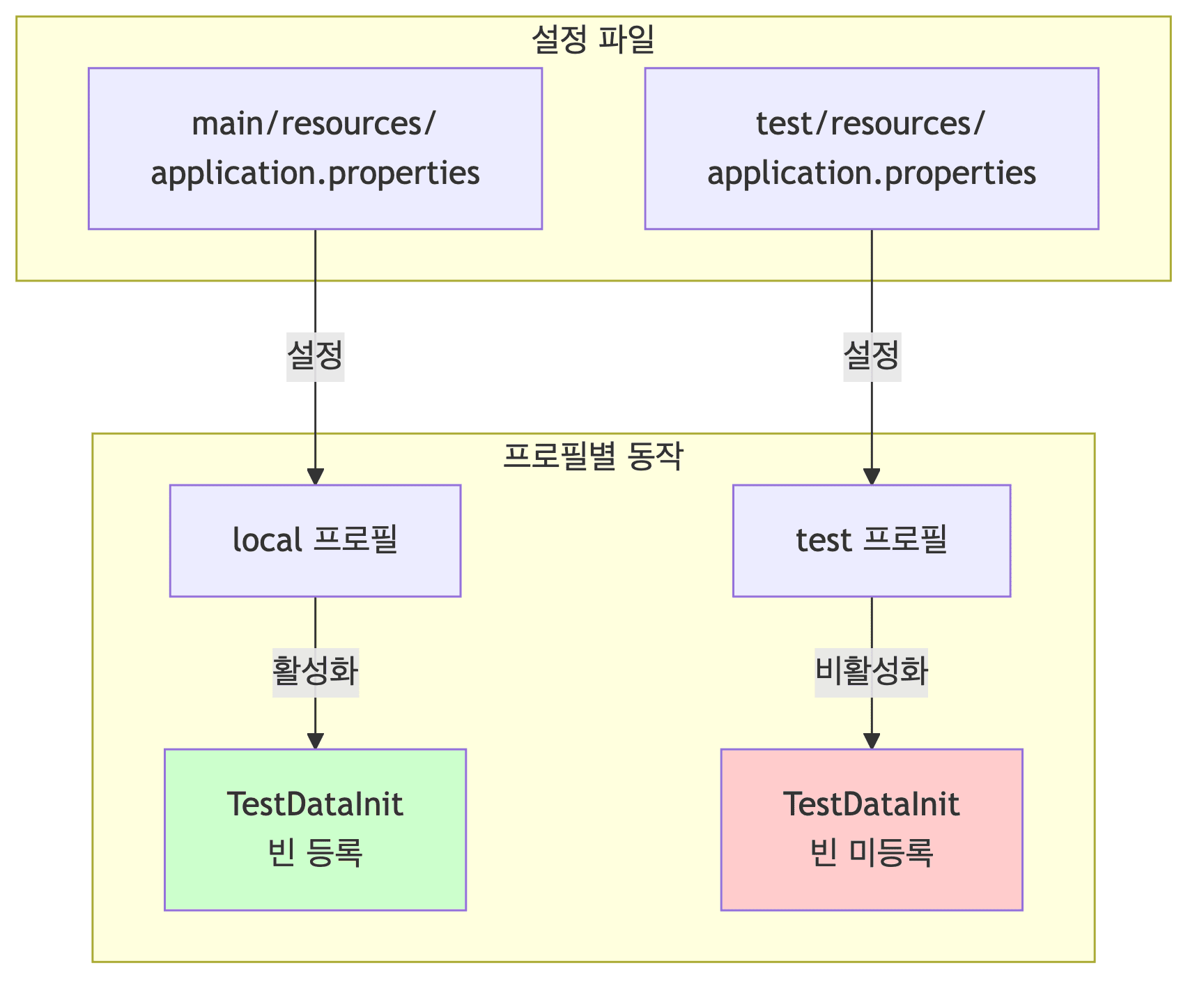
프로필 설정
-
main 프로필 (로컬 실행)
- src/main/resources/application.properties
1
  spring.profiles.active=local
- 결과
@Profile("local")이 활성화됨TestDataInit빈이 등록됨- 초기 데이터가 자동 생성됨
-
test 프로필 (테스트 실행)
- src/test/resources/application.properties
1
  spring.profiles.active=test
- 결과
@Profile("local")이 비활성화됨TestDataInit빈이 등록되지 않음- 깨끗한 상태로 테스트가 가능함
-
TestDataInit
1
2
3
4
5
6
7
8
9
10
11
12
13
14
15
  @Slf4j
  @RequiredArgsConstructor
  public class TestDataInit {
      private final ItemRepository itemRepository;

      /**
       * 확인용 초기 데이터 추가
       */
      @EventListener(ApplicationReadyEvent.class) // 스프링 컨테이너 준비 완료 후 실행
      public void initData() {
          log.info("test data init");
          itemRepository.save(new Item("itemA", 10000, 10));
          itemRepository.save(new Item("itemB", 20000, 20));
      }
  }
-
이벤트 리스너 선택 이유
@PostConstruct의 문제점- 빈의 초기화 시점에는 AOP(예:
@Transactional)가 아직 적용되지 않을 수 있음 - 이로 인해 트랜잭션 등 AOP 기능이 필요한 로직 실행 시 문제가 발생할 수 있음
- 빈의 초기화 시점에는 AOP(예:
ApplicationReadyEvent의 장점- 스프링 컨테이너가 완전히 초기화된 후에 실행됨
- AOP를 포함한 모든 빈이 준비된 상태이므로 안전하게 로직을 수행할 수 있음
테스트 전략
테스트 원칙
- 독립성
- 서로 영향을 주지 않아야 함
- 순서와 무관하게 실행되어야 함
- 반복성
- 항상 같은 결과를 보장해야 함
- 실행 환경에 독립적이어야 함
- 격리성
- 테스트 실행 전후로 데이터 초기화가 필요함
- 트랜잭션 롤백 등을 통해 상태를 격리해야 함
ItemRepositoryTest
-
1
2
3
4
5
6
7
8
9
10
11
12
13
14
15
16
17
18
19
20
21
22
23
24
25
26
27
28
29
  @SpringBootTest // 통합 테스트
  class ItemRepositoryTest {

      @Autowired
      ItemRepository itemRepository;

      @AfterEach // 각 테스트 종료 후 실행
      void afterEach() {
          // 메모리 저장소인 경우만 초기화 (테스트 격리)
          if (itemRepository instanceof MemoryItemRepository) {
              ((MemoryItemRepository) itemRepository).clearStore();
          }
      }

      @Test
      void save() {
          // given
          Item item = new Item("itemA", 10000, 10);

          // when
          Item savedItem = itemRepository.save(item);

          // then
          Item findItem = itemRepository.findById(item.getId()).get();
          assertThat(findItem).isEqualTo(savedItem); // 저장된 데이터 검증
      }

      // ... update, findItems 테스트 생략
  }
연습 문제
-
데이터 접근 기술 분류 중 SQL Mappers와 ORM의 주된 차이는 무엇일까요?
a. SQL Mappers는 SQL 결과와 객체를 매핑합니다.
- SQL Mappers는 개발자가 작성한 SQL의 결과를 객체로 매핑하는 반면, ORM은 기본적인 SQL을 자동으로 생성하여 JDBC 코드의 많은 부분을 줄여줌
- 둘 다 데이터와 객체 연동 방식에서 차이가 있음
-
프로젝트에서 DTO(Data Transfer Object)의 주된 목적은 무엇인가요?
a. 데이터를 효율적으로 전달하기 위해서
DTO는 주로 계층 간(예: 컨트롤러-서비스, 서비스-리포지토리) 필요한 데이터를 묶어서 전달하는 데 사용되는 객체임- 데이터 자체를 운반하는 역할에 집중하며 로직은 최소화함
-
Spring Profiles는 주로 어떤 용도로 사용되나요?
a. 환경별로 다른 설정을 적용하기 위해서
Spring Profiles는 개발, 테스트, 운영 등 애플리케이션 실행 환경에 따라 데이터 소스 설정이나 특정 빈의 등록 여부 등 다양한 설정을 다르게 적용해야 할 때 유용하게 사용됨
-
JUnit 테스트에서
@AfterEach어노테이션이 붙은 메서드의 주된 역할은 무엇일까요?a. 각 테스트 케이스 실행 후 데이터를 정리합니다.
@AfterEach는 각 테스트 메서드가 실행될 때마다 그 직후에 호출되어 테스트 간 데이터 오염을 방지하고 독립적인 환경을 유지하는 역할을 함- 테스트 격리를 위해 중요함
-
데이터베이스 테이블의 주 식별자(Primary Key) 전략으로 권장되는 방식은 무엇인가요?
a. 시스템이 생성하는 임의의 대체 키
- 비즈니스적 의미를 갖는 자연 키는 변경될 위험이 있어 식별자로 불안정할 수 있음
- 시스템이 자동으로 생성하는 임의의 대체 키(예: 자동 증가 숫자)는 변경될 일이 없어 안정적인 주 식별자로 권장됨
요약 정리
- SQL Mapper(JdbcTemplate, MyBatis)는 SQL을 직접 작성하며 결과를 객체로 매핑해주는 반면, ORM(JPA, Querydsl)은 SQL을 자동 생성하여 객체 중심으로 개발할 수 있게 도와줌
- 도메인은 비즈니스 로직의 핵심이 되는 객체(엔티티)이며, 리포지토리는 이러한 도메인 객체를 저장하고 조회하는 데이터 접근 계층임
- 서비스 계층은 비즈니스 로직을 담당하며, 리포지토리 인터페이스에 의존하여 특정 데이터 접근 기술에 종속되지 않도록 설계하는 것이 중요함
- 컨트롤러는 웹 요청을 받아 서비스를 호출하고 그 결과를 반환하는 역할을 수행함
- 스프링 프로필(Profiles) 기능을 활용하면 로컬, 테스트, 운영 등 실행 환경에 따라 데이터베이스 연결 정보나 빈 설정을 유연하게 분리하여 관리할 수 있음
@Configuration과@Bean을 사용한 데이터 소스 및 빈 수동 등록은 향후 구현 기술 변경 시 코드를 최소한으로 수정할 수 있게 해주는 유연성을 제공함- 테스트 격리는 신뢰할 수 있는 테스트 환경을 위해 필수적이며,
@AfterEach등을 사용하여 각 테스트 실행 후 데이터를 초기화하거나 트랜잭션을 롤백하는 전략을 사용해야 함