동적 프록시 기술
- 김영한님의 스프링 원리 - 고급편 강의를 바탕으로 동적 프록시 기술의 개념과 JDK 동적 프록시, CGLIB의 차이를 이해하고 활용 방법을 정리함
리플렉션(Reflection)
개념
- 프록시 클래스를 대상 클래스마다 직접 만들면, 코드 흐름은 같고 호출 메서드만 다른 중복이 발생함
- 리플렉션은 클래스나 메서드의 메타정보를 런타임에 동적으로 획득하고 호출할 수 있게 해주는 자바 기본 기술임
문제 상황과 해결
- 문제 상황
target.callA()와target.callB()처럼 호출 메서드가 다르면 공통 로직 하나로 묶기가 어려움
- 리플렉션 해결
- 메서드 메타정보를 획득하여 동적으로 호출함
1
2
3
4
5
6
7
8
9
10
// 클래스 메타정보 획득
Class classHello = Class.forName("hello.proxy.jdkdynamic.ReflectionTest$Hello");

// 메서드 메타정보 획득
Method methodCallA = classHello.getMethod("callA");
Method methodCallB = classHello.getMethod("callB");

// 동적 호출
Object result1 = methodCallA.invoke(target);
Object result2 = methodCallB.invoke(target);
-
공통 로직으로 통합
1
2
3
4
5
private void dynamicCall(Method method, Object target) throws Exception {
    log.info("start");
    Object result = method.invoke(target); // 메서드를 동적으로 교체 가능
    log.info("result={}", result);
}
흐름 요약

주의사항
- 메서드를 동적으로 교체해 공통 로직을 통합할 수 있다는 장점이 있음
- 하지만 컴파일 시점에 오류를 잡지 못하고 런타임 오류가 발생할 수 있음
- 따라서 프레임워크나 공통 처리 목적으로만 부분적이고 주의 깊게 사용하는 것이 좋음
JDK 동적 프록시
개념
- 대상 클래스가 N개일 때 프록시 클래스도 N개 만들어야 하는 문제를 해결하기 위해, 런타임에 프록시 객체를 동적으로 생성함
- JDK 동적 프록시는 인터페이스가 필수임
흐름 정리
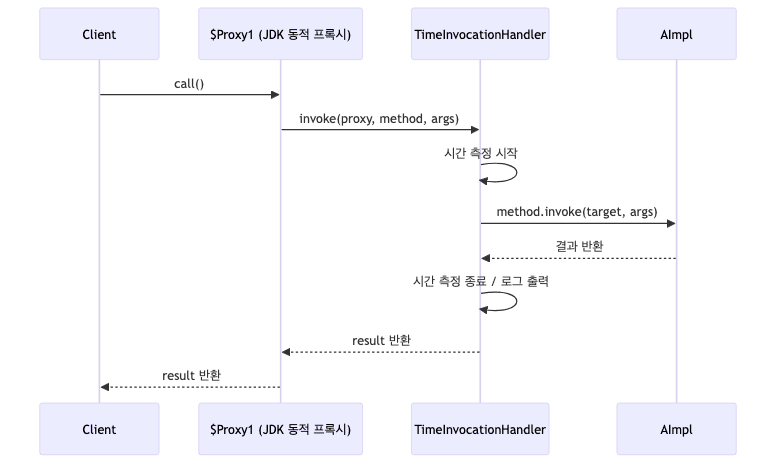
구현 코드
-
InvocationHandler필수 구현 (자바 제공)1 2 3
public interface InvocationHandler { Object invoke(Object proxy, Method method, Object[] args) throws Throwable; }
-
TimeInvocationHandler(기본 로직)1 2 3 4 5 6 7 8 9 10 11 12 13 14 15 16 17 18
@Slf4j public class TimeInvocationHandler implements InvocationHandler { private final Object target; public TimeInvocationHandler(Object target) { this.target = target; } @Override public Object invoke(Object proxy, Method method, Object[] args) throws Throwable { log.info("TimeProxy 실행"); long startTime = System.currentTimeMillis(); Object result = method.invoke(target, args); // 실제 대상 객체 동적 호출 long endTime = System.currentTimeMillis(); log.info("TimeProxy 종료 resultTime={}", endTime - startTime); return result; } }
-
동적 프록시 생성 로직
1
2
3
4
5
6
7
8
9
10
11
12
13
@Test
void dynamicA() {
    AInterface target = new AImpl();
    TimeInvocationHandler handler = new TimeInvocationHandler(target);

    AInterface proxy = (AInterface) Proxy.newProxyInstance(
        AInterface.class.getClassLoader(), // 프록시가 로드될 클래스 로더
        new Class[]{AInterface.class},     // 프록시가 구현할 인터페이스들
        handler                            // 프록시 호출 시 실행될 핸들러
    );

    proxy.call();
}
-
LogTraceBasicHandler(적용 예제)1 2 3 4 5 6 7 8 9 10 11 12 13 14 15 16 17 18 19 20 21 22 23 24 25 26
public class LogTraceBasicHandler implements InvocationHandler { private final Object target; private final LogTrace logTrace; public LogTraceBasicHandler(Object target, LogTrace logTrace) { this.target = target; this.logTrace = logTrace; } @Override public Object invoke(Object proxy, Method method, Object[] args) throws Throwable { TraceStatus status = null; try { String message = method.getDeclaringClass().getSimpleName() + "." + method.getName() + "()"; status = logTrace.begin(message); Object result = method.invoke(target, args); // 실제 로직 호출 logTrace.end(status); return result; } catch (Exception e) { logTrace.exception(status, e); throw e; } } }
-
DynamicProxyBasicConfig(빈 등록)1 2 3 4 5 6 7 8 9 10 11 12
@Configuration public class DynamicProxyBasicConfig { @Bean public OrderControllerV1 orderControllerV1(LogTrace logTrace) { OrderControllerV1 orderController = new OrderControllerV1Impl(orderServiceV1(logTrace)); return (OrderControllerV1) Proxy.newProxyInstance( OrderControllerV1.class.getClassLoader(), new Class[]{OrderControllerV1.class}, new LogTraceBasicHandler(orderController, logTrace) ); } }
주요 이점
- 프록시 클래스를 직접 만들지 않아도 됨
- 부가 기능 로직(
InvocationHandler)을 하나만 작성해 모든 대상에 공통 적용할 수 있어 단일 책임 원칙을 충족함
JDK 동적 프록시 - 적용 2 (메서드 필터)
한계점
/v1/no-log호출 시에도 LogTrace가 실행됨- 특정 메서드는 로그를 남기지 않아야 함에도 모든 요청에 대해 부가 기능이 동작함
구현 코드
-
LogTraceFilterHandler(메서드 이름 필터 추가)1 2 3 4 5 6 7 8 9 10 11 12 13 14 15 16 17 18 19 20 21 22 23 24 25 26 27 28 29 30 31
public class LogTraceFilterHandler implements InvocationHandler { private final Object target; private final LogTrace logTrace; private final String[] patterns; public LogTraceFilterHandler(Object target, LogTrace logTrace, String... patterns) { this.target = target; this.logTrace = logTrace; this.patterns = patterns; } @Override public Object invoke(Object proxy, Method method, Object[] args) throws Throwable { String methodName = method.getName(); if (!PatternMatchUtils.simpleMatch(patterns, methodName)) { return method.invoke(target, args); // 필터 미매칭 시 실제 로직 바로 호출 } TraceStatus status = null; try { String message = method.getDeclaringClass().getSimpleName() + "." + method.getName() + "()"; status = logTrace.begin(message); Object result = method.invoke(target, args); logTrace.end(status); return result; } catch (Exception e) { logTrace.exception(status, e); throw e; } } }
PatternMatchUtils패턴 규칙xxx- 정확히 일치 (
request)
- 정확히 일치 (
xxx*- 시작하는 문자열 (
request*)
- 시작하는 문자열 (
*xxx- 끝나는 문자열 (
*Service)
- 끝나는 문자열 (
*xxx*- 포함하는 문자열 (
*order*)
- 포함하는 문자열 (
-
DynamicProxyFilterConfig1 2 3 4 5 6 7 8 9 10 11 12 13 14
@Configuration public class DynamicProxyFilterConfig { private static final String[] PATTERNS = {"request*", "order*", "save*"}; @Bean public OrderControllerV1 orderControllerV1(LogTrace logTrace) { OrderControllerV1 orderController = new OrderControllerV1Impl(orderServiceV1(logTrace)); return (OrderControllerV1) Proxy.newProxyInstance( OrderControllerV1.class.getClassLoader(), new Class[]{OrderControllerV1.class}, new LogTraceFilterHandler(orderController, logTrace, PATTERNS) ); } }
CGLIB (Code Generator Library)
개념
- JDK 동적 프록시는 인터페이스가 없으면 적용할 수 없음
- CGLIB는 바이트코드를 조작해 구체 클래스를 상속하는 방식으로 동적 프록시를 생성함
- 스프링 프레임워크에 내장되어 있어 별도 의존성 추가 없이 사용할 수 있음
JDK와 CGLIB 비교
| 구분 | JDK 동적 프록시 | CGLIB |
|---|---|---|
| 생성 방식 | 인터페이스 구현(implements) | 구체 클래스 상속(extends) |
| 필수 조건 | 인터페이스 필요 | 인터페이스 불필요 |
| 구현 인터페이스 | InvocationHandler |
MethodInterceptor |
| 프록시 이름 예시 | com.sun.proxy.$Proxy1 |
ConcreteService$$EnhancerByCGLIB$$25d6b0e3 |
구현 코드
-
MethodInterceptor(CGLIB 제공)1 2 3
public interface MethodInterceptor extends Callback { Object intercept(Object obj, Method method, Object[] args, MethodProxy proxy) throws Throwable; }
-
TimeMethodInterceptor(적용 예제)1 2 3 4 5 6 7 8 9 10 11 12 13 14 15 16 17 18 19 20
@Slf4j public class TimeMethodInterceptor implements MethodInterceptor { private final Object target; public TimeMethodInterceptor(Object target) { this.target = target; } @Override public Object intercept(Object obj, Method method, Object[] args, MethodProxy proxy) throws Throwable { log.info("TimeProxy 실행"); long startTime = System.currentTimeMillis(); Object result = proxy.invoke(target, args); // method 대신 proxy 사용이 성능상 유리 long endTime = System.currentTimeMillis(); log.info("TimeProxy 종료 resultTime={}", endTime - startTime); return result; } }
-
CGLIB 프록시 생성 방식
1
2
3
4
5
6
7
8
9
10
@Test
void cglib() {
    ConcreteService target = new ConcreteService(); // 인터페이스 없는 구체 클래스
    Enhancer enhancer = new Enhancer();
    enhancer.setSuperclass(ConcreteService.class);           // 상속할 클래스 지정
    enhancer.setCallback(new TimeMethodInterceptor(target)); // 실행 로직 지정

    ConcreteService proxy = (ConcreteService) enhancer.create(); // 프록시 생성
    proxy.call();
}
CGLIB 제약 사항
- 자식 클래스를 동적으로 생성하므로 부모 클래스에 기본 생성자가 필요함
- 클래스와 메서드에
final키워드가 붙어 있으면 상속이나 오버라이딩이 불가능해 프록시 로직이 동작하지 않음
남은 문제
- 인터페이스 유무에 따라 JDK 동적 프록시와 CGLIB를 수동으로 나누어 써야 하는 불편함이 있음
InvocationHandler와MethodInterceptor두 가지를 모두 각각 구현해야 함- 특정 메서드 패턴에서만 프록시 로직을 적용하는 로직을 공통으로 빼기 어려함
- 이러한 문제들을 해결해 주는 것이 스프링의
ProxyFactory임
연습 문제
-
수동 프록시 방식의 주된 문제점은 무엇일까요?
a. 대상 클래스 수만큼 유사한 프록시 클래스 생성
- 수동 프록시는 대상마다 유사한 코드를 가진 프록시 클래스를 계속 만들어야 했지만, 동적 프록시는 이 문제를 해결해 코드 중복을 줄임
-
JDK 동적 프록시와 CGLIB 동적 프록시의 가장 큰 차이점은 무엇일까요?
a. 프록시 대상의 종류 (인터페이스와 구체 클래스 비교)
- JDK는 인터페이스 기반, CGLIB는 구체 클래스 상속 기반으로 프록시를 만듦
-
JDK 동적 프록시 기술을 사용하기 위한 필수 조건은 무엇일까요?
a. 인터페이스 구현
- JDK 동적 프록시는 반드시 인터페이스를 구현한 객체에만 적용할 수 있으며, 인터페이스가 없으면 CGLIB를 사용해야 함
-
CGLIB 동적 프록시가 JDK 동적 프록시보다 유연하게 활용될 수 있는 대표적인 경우는 무엇일까요?
a. 프록시할 대상이 인터페이스가 아닌 구체 클래스일 때
- 인터페이스가 없는 구체 클래스는 JDK 동적 프록시로 프록시하기 어려우므로, 상속을 지원하는 CGLIB를 통해 구체 클래스에도 프록시를 적용할 수 있음
-
동적 프록시(JDK InvocationHandler 또는 CGLIB MethodInterceptor)에서 별도 구현체로 분리되는 로직의 주된 역할은 무엇일까요?
a. 주요 기능 앞뒤에 부가 기능 적용
InvocationHandler나MethodInterceptor는 클라이언트 호출을 가로채서 실제 대상 객체 호출 전후에 부가적인 로직(예 로깅, 시간 측정)을 수행하는 역할을 함
요약 정리
- 프록시 클래스를 일일이 만들면 코드 중복과 유지보수 부담이 생기므로, 자바 기본 기술인 리플렉션이나 바이트코드 조작 기술을 활용해야 함
- 인터페이스가 있다면 JDK 동적 프록시(
InvocationHandler)를 사용하고, 인터페이스 없이 구체 클래스만 있다면 CGLIB(MethodInterceptor)를 사용함 - 동적 프록시를 통해 적용할 대상 클래스 개수에 상관없이 하나의 공통 프록시 로직만으로 확장이 가능함
- 다만 상황에 따라 두 가지 기술로 나누어 적용해야 하는 불편함이 있으며, 스프링 프레임워크는 이를
ProxyFactory단위로 한 번 더 추상화하여 통합 제공함